


Are You Alone in the Digital Age?
In today's digital world, anyone can sometimes feel isolated. But is this loneliness truly inevitable?
LEADERSHIP & CULTURE
Suphi Ramazanoglu
1/20/2026

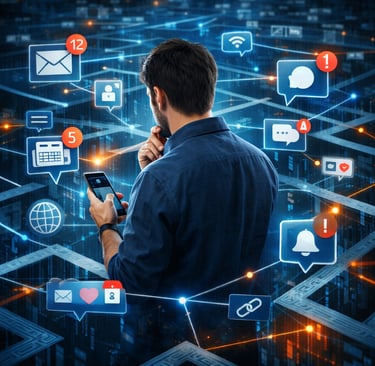
The inner voice of a technology person…
Every morning we reach for our phones. We check notifications, browse emails, and scan what's happening on social media. Before we even finish our coffee, we have already stepped into the digital world.
Technology is no longer just a tool that makes our lives easier; it has also become a part of our identity. The companies we work for, the applications we use, the networks we connect to… They all define us in some way.
But sometimes I can't help but ask myself: In all these connections, are we really connected? Or are we just pretending to be "connected"?
The Digital Paradox: More Connections, Less Contact
We live in an increasingly digital world every day. Technology is developing at a dizzying pace; things are getting more complicated, and processes are becoming automated. We are trying to exist within this change, even striving to lead it.
The ironic thing is: We humans design these digital solutions, these complex systems. We are both the architects and the users who get lost within them.
Looking back in history, I can't help but wonder. If Nicola Tesla, Leonardo da Vinci, or Alan Turing were alive today, what would they achieve with these technologies? Maybe they would push the boundaries much further. But perhaps they too would struggle with the distractions brought about by this speed. Because human nature was not evolved to handle multiple tasks simultaneously. Our brains are designed for "finding meaning," not for "multitasking."
The digital age, however, demands more from us: faster reactions, more data, shorter time. While productivity seems to increase, mental fatigue and burnout grow silently on the other side.
Invisible Loneliness: Alone in Crowds
Screens offer us unlimited communication opportunities. We can now work simultaneously with teams from different countries, manage projects in the cloud, and participate in meetings from miles away.
This is an incredible advancement. But there is another hidden side to this: As everything moves to the virtual space, physical contact decreases. The tone of a human voice, the warmth of a glance, the trust conveyed by a smile — all become pixels.
And this situation sometimes leaves us with a deep sense of loneliness without us even realizing it.
Yes, meetings are full; calendars are hectic; Slack or Teams notifications never stop. But how often do we truly feel that we are "connected" to someone?
Most of the time, not at all. Because digital communication is fast yet superficial. It is efficient but devoid of emotion.
This is where the main question arises: As we digitalize, how much can we preserve the essence of being human?
Creating Quiet Spaces in Digital Noise
Sometimes, we all need to pause and reflect. Just lifting our heads from the screens and looking around for a few minutes — creating "quiet spaces" during the day — can make a real difference.
This doesn't require a major meditation discipline. Sometimes, simply looking out the window during a coffee break, or genuinely asking a colleague "how are you?" is enough.
In the digital age, mindfulness is not a luxury — it is a survival skill. Because choosing to slow down in the middle of speed means preserving our own inner balance.
If we don't manage technology, it manages us. And taking back control is possible through small but conscious choices:
Turning off screen notifications a few times a day,
Creating "screen-free time" once a week,
Choosing to listen rather than just talk in meetings,
And perhaps most importantly, creating spaces for face-to-face connection rather than digital-only interaction.
Real Connection Is in Touch and Sight
I admire technology. I am grateful for the way it has made life easier, shrunk the world, and democratized access to knowledge. But in the middle of all this, we must not forget the essence of being human.
Sending a message is easy. But looking someone in the eye and saying "thank you" carries a different kind of energy. Writing an email is effective. But sharing ideas over a coffee builds far more lasting relationships.
Perhaps the balance lies exactly here: Building a bridge between the digital and the human. Seeing technology as a tool, not a refuge. Connecting with people, not devices.
Today we have incredible capabilities — AI, automation, data analytics… But there is one thing we must not forget: we pass through this life only once. When there are people around us who love and believe in us, replacing them with digital interactions is a great loss.
We should ask ourselves: "In the last 24 hours, how many people did I truly connect with? How many did I simply pass by with a message?"
If we answer this honestly, we take one step closer to finding our own digital balance.
Looking vs. Seeing
In the pace of life, we sometimes only "look" at the world around us. But "seeing" requires slowing down. Seeing means noticing a moment, feeling an emotion, catching the meaning in someone's eyes.
In the digital age, seeing means awareness. And awareness is an antidote to loneliness.
Perhaps after reading this, you will choose to visit someone instead of sending a message. Perhaps in a meeting, instead of just speaking, you will look into the eyes of the person across from you. Perhaps today, you will call a friend you haven't reached out to in a long time.
In that moment, you will have taken the first step against digital loneliness.
Because there is a difference between looking and seeing. And that difference is what makes us human.
Contact
info@suphiramazanoglu.com
© 2025–2026. All rights reserved.
📬 Monthly Insights
Regular content on digital transformation, agile, and leadership.